What is a fast shot?
A properly extracted espresso should take 25–35 seconds from the moment the pump starts to when you stop the shot. This is measured from when water first contacts the coffee puck (not when coffee starts flowing from the spout — there's typically a 5–8 second delay).
If your shot finishes before 20 seconds, water is rushing through the puck too quickly, extracting only the first, easiest-to-reach compounds — which are sour and thin — and missing the balanced, sweet middle of the extraction curve.
Why shots pull fast
- Grind too coarse: The most common cause. Large particles offer less resistance, so water rushes straight through.
- Dose too low: Less coffee in the basket means the puck is thinner and creates less resistance.
- Tamp too light: A loose puck lets water find channels through the coffee rather than percolating evenly.
- Channelling: A crack or hole in the puck lets water short-circuit through one path. The shot pulls fast but looks normal until you inspect the spent puck.
- Distribution problems: If the coffee isn't evenly distributed before tamping, thin spots in the puck create low-resistance paths.
How to fix it — in order
Step 1: Grind finer. This is almost always the right first move. Move your grinder one or two notches finer and pull another shot. The flow should slow and the shot should take longer. Continue adjusting until you hit 25–35 seconds.
Step 2: Check your dose. If grinding finer alone doesn't slow the shot enough, increase your dose by 0.5 g and try again. Most espresso recipes use 18–20 g for a double shot.
Step 3: Improve your tamp. Use firm, even pressure — roughly 15 kg. More importantly, make sure the tamp is level. An uneven tamp creates a thin edge where water channelled through. Use a levelling tool if available.
Step 4: Distribute before tamping. Use a WDT tool (Weiss Distribution Technique) or simply tap the portafilter on the counter a few times to settle the grounds evenly before tamping. This eliminates channels and clumps before they become a problem.
What a dialled-in shot looks like
A properly extracted espresso starts as a slow drip 5–8 seconds after the pump starts, then builds to a steady, honey-like flow. The colour should be a warm amber-brown — not pale yellow (under-extracted, too fast) and not dark brown that fades to black (over-extracted, too slow). Aim for 25–35 seconds total and a yield of roughly 1.5–2× your dose weight.
Slower isn't automatically better
Once you've slowed a gushing shot down into the 25–35 second window, it's tempting to keep chasing a longer time. Don't. Shot time is a symptom, not the goal. A 30-second shot can still taste sour if the puck channelled, or hollow and bitter if you got there by grinding far too fine and choking the flow. Two shots with identical timings can taste completely different.
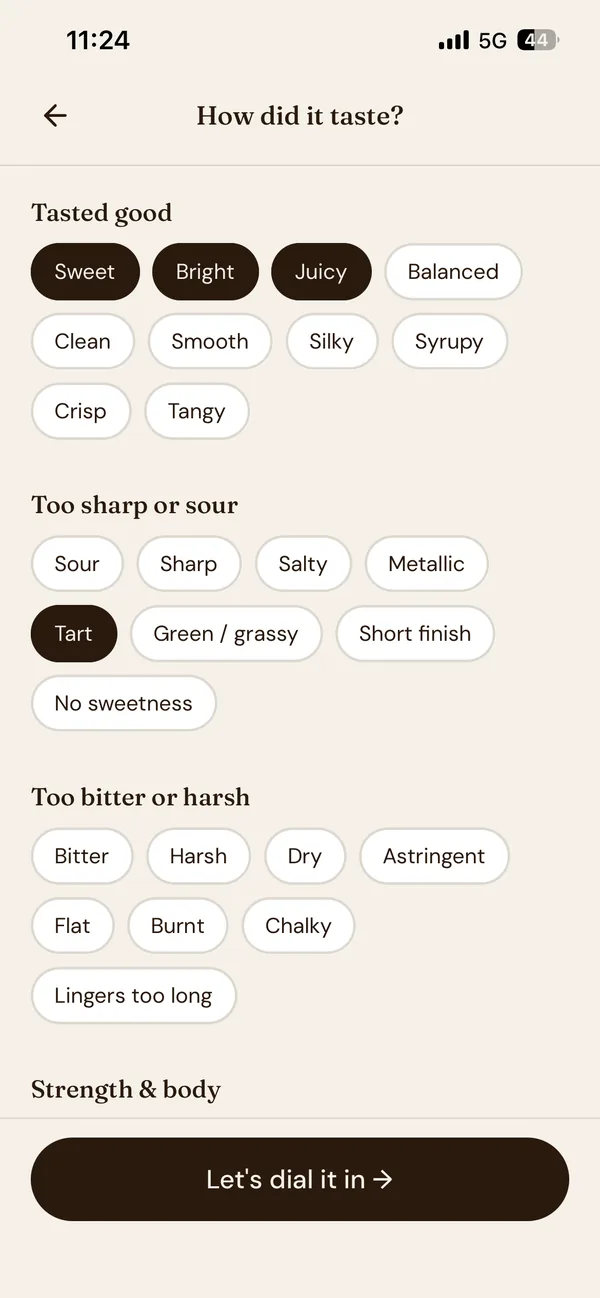
The only thing that tells you whether a change worked is the cup. Sour and thin means you're still under-extracting. Bitter and dry means you've overshot. If the timing is right and it still tastes wrong, the problem has moved — to distribution, dose, or temperature — and changing the grind again won't find it.
That in-between stage is where most home baristas get stuck: the shot looks right, tastes wrong, and every guide hands you a different variable to try next. The jump from "fast shot" to "good cup" is rarely one change. Working out which change actually matters for your shot is the hard part.
Common questions
Why is my espresso pulling too fast?
The most common cause is a grind that's too coarse. Other causes include: dose too low, tamp too light, channelling in the puck, or uneven coffee distribution before tamping.
If my espresso is pulling too fast, what do I do?
Grind finer first — one or two notches — and pull again. If it's still under 20 seconds, add 0.5 g to the dose. Then check that your tamp is level and your grounds are evenly distributed. Change one thing per shot.
Should I grind finer or coarser if espresso pulls too fast?
Finer. A finer grind creates more resistance, so water takes longer to get through the puck. Grinding coarser would make the shot even faster.
Why is my espresso coming out too fast?
Water is finding too little resistance in the puck. The usual causes, in order: grind too coarse, dose too low, a light or uneven tamp, or channelling through a crack in the puck.
How long should an espresso shot take?
A properly extracted espresso should take 25–35 seconds from when the pump starts. If your shot finishes before 20 seconds, it's under-extracted and will taste sour and thin.
Does a slower shot mean better espresso?
Not by itself. Shot time is a symptom, not the goal. A 30-second shot can still taste sour if it channelled, or bitter and hollow if you got there by grinding far too fine and choking the flow. Use the timing to get into the 25–35 second window, then let taste decide the next change.
What does under-extracted espresso taste like?
Under-extracted espresso tastes sour, thin, and weak. The colour will be pale yellow rather than warm amber-brown. Shots that pull in under 20 seconds are almost always under-extracted.